Thursday, December 1, 2022

      Yoshiaki Yamashita – Making Your Randori Work 


     Let’s get into our time machine and go way far back in judo history for some randori advice from the first of the best, Yoshiaki Yamashita. He was the first Kodokan 10th dan. Yamashita gave 14 strong admonitions for becoming better at your judo. We can use the first four as essential points relating to randori. 

            In 1884, he became the nineteenth member of the Kodokan. After three months he earned his first dan ranking. After two years he received his fourth dan. In 1898, he received sixth dan. He was a member of the Kodokan teams that competed against the Tokyo Police dojos in the battles that created the initial and rapid popularity of the Kodokan. In 1903, he went to the USA where he taught judo to President T. Roosevelt and at the U.S. Naval Academy. If you do some online searches, you’ll see all of his suggestions, plus other very cool information about other aspects of his judo, including a video of him doing nage no kata at age 65.

            (Italics are his comments.)

1.      Study the correct way of applying the throws. Throwing with brute force is not the correct way of winning in judo. The most important point is to win with technique.

              Many think that to knock somebody down onto their back in both randori and shiai in whatever manner you can is good. Yamashita says no. To achieve a technically correct judo throw is a significant accomplishment; one to be proud of.  It is the accomplishment of the finer details and application of the biophysics, the timing, the chess moves of the “game”, all combined, that provide the ultimate rewards. These go far beyond the blunt and often overly lauded throws achieved by any means available.

          Throwing a person while you are wearing a judogi doesn’t necessarily mean you’ve done judo.  There are some things that apply to all correctly achieved judo throws.  To be a judo throw, a throw must use kuzushi, tsukuri, and kake. Each one is a separate study, and the blending of them is also its own challenge. In all endeavors, ask yourself, “Where is each in the throw I am studying?” Then add, “How can I best make each happen?”  You first need to know in what direction the kuzushi is applied. Next, the form of the throw has to correctly conform to the laws of physics. The kake should end with control. This last one puts a considerable amount of question to front rolling throws.  

            My advice is to try to complete a throw with zanshin. This is standing in a composed and alert posture and mental state. Here is a standard and repeated definition, “… a state of awareness, of relaxed alertness, in Japanese martial arts. A literal translation of zanshin is 'remaining mind'. In several martial arts, zanshin refers more narrowly to the body's posture after a technique is executed. Sacrifice throws and makikomi throws have finishing postures that also comply. Zanshin speaks to Samurai battlefield success.

          I have a personal pet example. I don’t believe that initially learning uchi mata as a head diving, last moment kake application is in concert with Yamashita's advice. It is potentially massively dangerous, seems not to care about kuzushi and tsukuri and more about brute force, as the kake shows. 

        With this in mind, if you first learn any throw in its Kodokan standard version,  finishing standing and in control, before doing a "competition" or online variation, you can then learn how to apply your understanding of it to other options with possibly useful results. 

2.         First learn offense. You will see that defense is included in offensive. You will make no progress learning defense first.

            Learning to behave and think defensively can be a natural trap. The challenge of not being defensive when first doing randori is huge. Relaxing and seeking to focus on attack rather than rigidly keeping a randori partner at bay is contrary to our nature. Once a couple of counter techniques are known, it is easy to want to “wait in the weeds” and ambush your partner. 

            This can carry over into ones ongoing study and become too much a part of randori, perhaps forever. It leads to rigidity of the arms and body, making throwing more difficult. A judoka has to be relaxed prior to starting a throw; because muscles don’t move when tight, but must be relaxed to begin action. Bent over posture, overly defensive body positions are not conducive to good randori. When both partners are defensive, fewer throws are attempted and those that are can be both ugly and possibly result in injury. Shizentai is the best posture for both offense and defense. If you aren’t sure what that is, you owe it to yourself to find out and apply it.

            There might be some irony here. Because defensive bent forward posture was considered not dynamic and not attractive judo, and because it seemed to be a major defense against shooting leg grabs, leg grabbing and even touching the hand below the beltline, became a penalty. Bending over that way had been a penalty, too, but rarely called.  Now, players frequently bend over excessively as a common posture and no penalty is called. Perhaps we might consider creating a new penalty for a new offense: Ugly Judo.

3.      Do not dislike falling. Learn the timing of the throw while you are being thrown.

            I know judoka who get up with a big smile from having been thrown by a really nice throw. Feeling the essence of the good throw definitely helps provide a sense of how a throw works, both the overall parts and the throw specific ones. Whenever possible, I would volunteer to be uke for senseis teaching a throw. I tried to become such a good uke that senseis and others chose me to be uke for their demonstrations. It seems to me I learned more that about the technique being taught than did those watching.

            Here’s a fun trick. Sometimes in randori you can have fun by saying to yourself you will let your partner’s next throw succeed. If the throw is tried and doesn’t, not because of any defensive response from you, you learn about the amount of effort required to thwart offensive techniques. Sometimes the partner’s lack of proper technique will be all you need for defense.  This will help you to relax and focus on your own offense. You will also learn the vulnerabilities of a poor attack and be better able to deal with all attacks, using maximum efficiency.

4.            Practice your throws by moving your body as freely as possible in all directions. Do not lean to one side or get stiff. A great deal of repetition in a throw will be rewarded with a good throw.

            It is often our own rigidity that creates our biggest throwing problems.

            In randori, not attempting throws while just waiting for it to feel like the “right” time, is wasting precious time. By moving your body freely and loosely, and relaxing, the opportunities for throws will become more prevalent. They were always there, but you now have given them the opportunity to be discovered.  If you make a throwing effort and it doesn’t work, you will still have the opportunity to learn from this. Try throws frequently, and be sure to get loose first. Judoka who have learned to be more fluid in randori will tell you that they consider this a major forward step in their judo progress.

Bonus Yamashita advice, Number 14 - There is no end in learning JUDO. 


Wednesday, November 9, 2022


Making Your Judo Work

The Magic of "Not Try - Do"


If you’d like to magically improve your judo faster, easier, and with lasting results, this is the blog for you.

     As a sensei, I've seen a zillion and a half people immediately fail at a judo task, get frustrated, get nowhere. The sensei says, "Fix this one thing." If it is done, there is success, and if not, more failure. Over time, a couple more "one things" have to be taken care of. Each requires making a single and concerted effort to fix it. Let’s consider the “One Thing”.

   I was telling a new student to do a simple head rotation when performing hane goshi. (For those who know my judo, it is "Sunrise - Sunset".) It requires zero special athletic ability. If you look up at the ceiling and then over toward your rear, as if watching a ball go up and over your head - that means up and around, not sideward and around, you'll have it. (This is the fix for just this example, not singularly the essence of this blog.)

     This is an action that can make a floundering hane goshi almost magically really good. It can be used for all front throws, but hane is the most glaring proof of its efficacy. That aside, it is as easy as wrinkling your nose. 

     The student was not being asked to perform anything that would muddle up the other things going on for the throw. In fact, the rest of the throw effort looked functionally okay. This student did it and the throw actually worked. Then, the student would do it once, maybe even twice, and then proceed to stop doing it. Over about thirty minutes of class practice time he was admonished to make it happen several more times, because he continually reverted to his old way. Perhaps you are thinking, "Well, there's always that student who just can't get it." Forget that. This happens over and again with student after student, and not just with this fix or this throw, and not with just throws.  Every judo technique can provide the opportunity to apply the advice given here. (Not the head rotation, the general advice.)

     We so often hear that the martial arts enhance that mystical ability called "focus". This is a big selling feature when parents are enrolling kids. There is no need to get mystical about it; it is simply very specifically paying attention, then doing.  Just for fun, let’s pretend you need to do something to improve any throw you'd like to name right now. My advice to create a major fix will be, "Wrinkle you nose as you do it." You do, and the throw is amazingly better. You do it again, and once more you get the reward. Will you always wrinkle your nose when trying this throw? Unless you are the exception to the overall world of judoka, you won't. The Gremlin that is you predominant action will override your newly achieved effort, because that is what happens to almost everybody almost all the time. 

    The frightening truth is that this “Gremlin”, this need to do the fix, can return way down the road. Only more and more practice can embed it. Practice makes permanent.

     It is human nature to revert to doing it incorrectly, because the original flaw is part of the student. It is what the individual's internal mechanism likes best, wrong or not. Fixing this requires that one do, not try. Okay, try to always do. 


·        Here's one way to make the fix permanent. One of the great values of uchi komi is that it provides opportunity to fix the little things repeatedly and with immediate focus.  Uchi komi, however, all too often is mindless repetition. While it provides a great place to drill the little things into shape, it can also drill the bad things into place.  

·        Another way is to do a mental command. If you need to do a special collar hand twist, mentally command “Twist collar hand”. If it’s a deeper foot placement, mentally command “Deeper step in”. Do this during uchi kkomi and in randori.

·        Try visualization (but not while driving J). Find a time when you can visualize and “feel” the action. Call it mental uchi komi.

    • The "feel" here is a valuable ability. If you can feel yourself doing what you mentally imagine, you can train your mind / body reactions for actual applications. If you can't just do it, try to learn to do it. Sometimes, just one part of an action can be achieved as a starter.


·        Make a video of you doing the technique. See if you can do it with and without the “Gremlin”. Study it.

     Trying to always do does not require getting a mental or physical hernia. It means to do it, and do so because you tell yourself to do it. Then, always do it. 

     The irony is that this blog is a single suggestion which readers might apply once or twice, and then not apply the next time. Therefore, make a part of your judo and it will magically make your judo work faster, easier, and with lasting results.


Monday, September 19, 2022


    Einstein plus Musashi = the One Thing = Good Throws 

    Einstein's theory of general relativity and Musashi's wisdom in The Book of Five Rings -The Ground Book have something universally in common. Einstein provided us with the an understanding of  what we use to make GPS work, why gold is yellow, and what's going on with the cathode ray tube that was the first television. Other uses of atomic energy go on and on. 


    Musashi would have told us to look at the giant boards of equations that made up Einstein's formula and then see them all in one simple truth. That truth, "as a straight line in the dirt", explains all things on that line. 

Here is Einstein's One Thing. 

E=MC2

A Small Part of Einstein's big formula


    This is true in judo throwing. Like Musashi's simple advice and Einstein's "simple" theory, a judo throw works because it is simple. Einstein also quipped, "Make everything as simple as possible, but no simpler." Although this seems to be a humorous comment, it could also mean that any further simplification would also mean elimination of something that is crucial, hence making the thing useless. 

    In judo nage wazaUki Goshi, the floating hip throw, gives us a very simple and complete example of the implementation of a throw, all its essentials. It is as simple as possible. 

     Here is the throwing formula.


    Let's look at Uki Goshi


 Here is the throw as kuzushi is about to become tsukuri and the action moves on to kake. 

  • Pink Triangle shows kuzushi has occurred, due to an initial, gentle  downward then upward motion of the sleeve hand (tsurite).
  • Middle pink arrows show the connection of the fulcrum point, a rendezvous, below uke's center of mass, as well as the tori's body angle that complements directional application.
  • Lower orange arrows: As the left foot comes down and the leg then applies upward pressure, it then combines with the rendezvous to then go to the upper orange arrows.
  • Upper orange arrows: These blend with the other actions to continue the throw to completion. 
  • Missing: An arrow at the tsurite elbow is need to show the ongoing pull of the kake, which is often not performed and the tsurite fails as it comes to rest at the current point. 
  • The right foot position is only a step in for positioning and the left foot and leg will bring the physical power to the throw. 

Let's make it simple and not anywhere near as complicated as Einstein's blackboard or my throwing formula. Here's the "E=MC2" of judo.      

- means combined

pK Ts  K = T

    Pre kuzushi combined with kuzushi combined with tsukuri combined with kake equals any and all judo throws. Combined is the operative word. It can also be emphasized that any throws not containing this full formula are not judo throws. They are only "throws", or "tosses" or "flips" and so on. The formula represents the physical equivalent of maximum efficiency via optimum use of energy. 

 Combined

          “Combined” is the secret beneath the otherwise familiar triad of what a judo throw is. This applies very much to how you practice a throw. Although we are considering all upright front throws, the principle applies. That principle is, “Don’t stop.”  “Combined” does not mean “in addition to…”. Think of it as “blended”, “integrated, “incorporated”, “unified”, “cohesive”, “amalgamated”, and such.

          In learning a throw, it is normal to step in and check to see if everything is in the right place. Often, this is the result of having been instructed to do a certain corrective thing; put the collar hand here, get your hip across more, get lower, etc. We step in and check to see if we’ve done it, or we step in to check how it “feels”. To do this, we stop. Then, we try to continue the throw. At this point, it has ceased to be a judo throw. I see this over and over again, and the students who do it have a difficult time not doing it; or, if you will, undoing the tendency. It then carries over to randori. That is because practice makes permanent.

Of course, at first one needs to check the parts, with the rare exception of those who can just watch and then do immediately. There comes a time, though, when the practice must be of the combined actions. You might be thinking, “Sure. That’s when we do nage komi, the throwing practice. Sadly, the tendency can carry over into this, too.

          Done correctly - If the kuzushi is correctly applied, the moment of blending in the tsukuri will create enough of a throw so that you will apply the kake in an almost “catch up” manner.

     This is the "one thing" of which Musashi spoke.

    Neither philosophies nor cosmic theories are of any value unless they are usefully applied.  It is easy to say, "I get it." It is not easy to say "I do it." Well then, what is it we must do? 

1.     Understand each part as it applies to the throw. 

2.     Include every part of the throw.

3.      Combine each part correctly.

`Thereby, if you put the methodology and genius of Einstein together with the super warrior wisdom of Musashi’s one simple truth, it will make your judo better.


Wednesday, August 31, 2022


 The Support Foot


        Your throw's success or failure depends upon the position of your support foot.        

 Fix the foot! 

    The support foot is the foundation of all throws. If I watch you do a throw that isn't working, the first thing I look at is your support foot placement. That is the primary problem the vast majority of the time. It might be only one of more, but unless it's fixed, nothing else is going to matter; and if it is fixed, it can often go a long way toward fixing the other concerns. 

     A misplaced support foot destroys kuzushi. Kuzushi works in concert with the placement of your support foot. If they are not in harmony, the kuzushi vanishes. 

     The support foot is the place from which power is driven as the throw goes from tsukuri to kake. It is also the place where tori's body is initially correctly positioned to maintain balance throughout all parts of the throw's progression. 

     Try this. Do a right hand o-goshi just up to the point of beginning the kake, the lift and rotate. Lift up your left foot. You will discover that bringing uke over is close to impossible. Lift up your right foot, however, and your left leg will drive the throw successfully. All throws have a dominant power leg, even those that seem to have both feet evenly on the ground. 

     Every throw has a place where that power foot should be. You probably know the spot. Then along comes randori and the foot just doesn't get there. 

  • The first step into a throw is the last step of walking. That sets up the ability to put the support foot where you want it.
  • In uchikomi and nage komi, focus on that spot for every repetition.
  • In randori, try to make this be the main thing you do. Forget about the rest of the throw (assuming you know it to some degree of familiarity).

     This becomes both the simplest and the most challenging of fixes. It's your foot! Unless uke has a prehensile tail reaching down and controlling it, you can put it anyplace you want. However, you must do more than simply "want" to. There are reasons you are putting it in the wrong place. We don't need to examine them. They are gremlins, and you cannot kill them with wishful thinking. We have to know they exist powerfully and they always try to return.

    Gremlin killer: Single-Minded Uchikomi and Single-minded Moving Uchikomi

    Gremlins don't just go away. They have to be intentionally and totally destroyed. Knowing a needed fix and saying, "Oh, okay. I'll fix that" won't. I've seen gremlins seem to be conquered, be gone for months, then return with a vengeance. I've also seen someone fix a problem on the spot, and then half an hour later it returns. You sometimes hear a judoka, often a sensei, say, "In judo, your toughest opponent is yourself." It's almost a shrug-it-off cliché. Support foot gremlins are among those personal opponents. 

     Practice makes permanent. Be careful, because this also means that while doing uchikomi to correct your foot placement, any mistakes you are making elsewhere in the practice will become more concrete. All too often, uchikomi becomes a mindless repetition of what we think the throw should be, and we make bad technique more permanent. 

        This is why single-mindedness is important. Perhaps the most challenging part of learning any physical skill is focus. There are separate methods out there to supposedly help you concentrate better. Here's one you might like. In uchi komi, have uke say "Foot!" to you before each entry. Also, if uke knows where you are trying to put your foot, uke can tell you if you are getting off target. If you don't have an uke doing it, do it yourself.

    Often, when watching a high level Japanese training session, the uchikomi features a strongly stomping first foot step by all the trainees. I recommend doing the stomp. 

     More Than Just a Spot

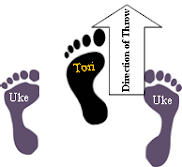
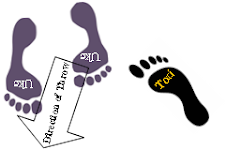
    Support foot placement is more than just a place on the mat. Correct placement also means the direction in which the toes point. Uchi mata and sasae tusurikomi ashi are special examples of toe misdirection, along with position error. FYI - Study how they are done in Nage no Kata. Look at the support foot, where it is and the angle its big toe points relative to the central action of the throw. If you don't do kata, then watch a world class demonstration and see it that way. Actual experience is a highly preferred way to appreciate this.

    In right uchi mata, at kake, the support toes should point to what would be tori's front, not to tori's right. In practice, an even larger turn of the support foot to the left is recommended, because that will compensate for when the foot tries to point to the right.  

    In sasae, the support foot should be outside of uke's non-propped foot line and the toes pointed inward, not on a line parallel to what would be the "railroad tracks". 

    In both cases, the Nage no Kata foot placements are excellent examples.  

        Uchi Mata             


                                                        Sasae Tsurikomi Ashi

(The purpose of these illustrations is to show placement angles. As to specific, exact, spot on placements, let's please not quibble.)

    Another common foot flaw

        Flat footed endeavors cause the knees to be vertically back (behind) the toes, and they should be on a dropline position ahead of them. Flat footedness also takes away final lifting and rotation action, which in turn eliminates a couple of dynamic inches of vertically forward thrust. Almost all, if not all throws should put tori in a position at tsukuri to kake where the knees are in front of the toes, the chest in front of the knees, and the nose in front of the chest. Any other position creates physical counter leverage. 


    Watch it Done Right

          Watch the successful judoka in your own dojo, or look on the Internet. 

Sadly, there will not likely be any discussion of foot placement. The best throws are those that require no hopping and no head diving. If a hop works it is too often because of an eventual and unintentional correct support foot placement during the hopping. Or, it succeeds because it wins by attrition. Head dives are a compensation for a lack of many bio-physical throwing essentials, and chief among them is support foot placement. Many judoka practice doing head diving throws, and this is a subject for another blog. My personal opinion is that the online high level competition judo coverage glorifies it. For now, suffice it to say that this sensei considers this dangerous and bad judo. Rolling over on uke when the throw is so dynamic that the momentum forces this, that is okay. Using head diving to make the kake work is not. 

In Randori

    A major objective of randori should be to work on things that need improvement. Here's an idea. Get someone to video your next few randori sessions from your knees on down and watch to see where you put your support foot for each attack. Look for nothing else. Isolate. For best results, be sure your sessions have several attacks. 

    Also, try this. Rather than have a specific throw in mind, just have a specific foot placement in mind, and let the throw follow. 

        It's Your Foot - Train it

    Sometimes, it seems our feet have little contrarian brains of their own. They just do what they want to do, no matter that you know better. You are unlikely to achieve total foot control quickly, because this is a gremlin that keeps wanting to come back tenaciously. Be master of your own feet. 

    We should never have to say, "I can't do this throw!"

    "Why not"

     "My foot won't let me."

      If ever your throw is admired by another judoka and you are asked your secret, you can smile slyly and say, "It's simple. I trained my foot." (Do not add "Grasshopper" to your reply.)


Tuesday, August 16, 2022

True Tipping Point

            So, you'd like to throw like legendary Kyuzo Mifune.            

            Don’t mistake the following for theory. It is something that you need to apply to your randori, and that you perpetually practice.


If you want to throw somebody with a really great throw, the best option is a judo throw. Because, to just do a “throw” you could simply pick somebody up and throw them across the room. Or, you could heft the victim onto your side, then fall on them, dragging them down under you. Those aren’t judo throws. They are just throwing. 


A judo throw requires a tipping point, plus a fulcrum, over which the uke’s body rotates and causes uke to land on the back.  Shiai points can be gained by throws that aren’t technically judo throws, and far too often are. In fact, many pictures are taken of these as examples of “dynamic” judo. These are not the goals of a true judoka.


Watching judoka practice a throw and not have success often shows the major issue involving tipping points. A successful judo throw is an uninterrupted single action that contains three essential elements. What we see instead is tori stopping at the moment between what should be the tsukuri and the kake. Then, often, without any kuzushi in the action, some lifting power is brought into play, and in spite of the results, we no longer technically have a judo throw.


This tells us the throw attempt’s failure is due to either missing kuzushi or improper fulcrum point placement, often both.


If at this point you might be thinking, “Duh! Everybody knows this.” If so, then let’s ask why these things are a perpetual cause of throw attempt failures.


     Let’s digress. Take a glass and set it on a table. Nudge it closer and closer to the edge, until it is almost ready to fall off the table. There is a position at which the glass is on the table. If nothing changes, it will stay there forever. There is an almost immeasurable point where if the base of the glass is moved farther off the edge, or if the top of the glass is leaned over the abyss, the glass will fall. It won’t stay suspended in space. This is when the throw should happen, as irrevocably and instantly as the glass tumbling off the table. It should take place at the tipping point.


The continuous and contiguous action of the three elements has stopped at the moment when the third element should have begun. Often, at this point, the tori will make an extra physical effort to complete the throw. It could be bending forward at a ninety degree angle. It could be trying to lift the uke up off the mat. In randori or shiai, it could be head diving. It is no longer a judo throw, but just a throw done during a judo activity.


            When kuzushi meets tsukuri, the tipping point has happened and kake is in progress. There should be no discernable time between that moment of connection and the accomplished throw. It should be like stepping off a cliff.


All too often, this is where we see physical strength and / or added body bending happen.  Once into the actual kake, it can have its own problems, chief among them the discontinuation of the pulling hand. This all for later.


When doesn’t a tipping point tip? When the fulcrum point is not harmoniously conjoined with the movement of the off balanced object.


When watching a throw, we see the big action, the kake. When learning a throw, we get involved with the new architecture of it, the form. Kuzushi is mostly just pointed out and then demonstrated as a pull or a push in a certain direction. What we don’t see is that when kuzushi and tsukuri have a rendezvous, the throw is happening at that instant. The amount of time involved is zero. It is like stepping off that cliff. The tipping point has arrived and the result is kake. There are no pauses, no action breaks, no grunts, bends, butt thumps or face plantings. Uke is airborne. 


Kyuzo Mifune is considered the epitome of judo technique. There used to be a quip that if you blinked one eye while doing randori with him, you were off balance to that side. It is important to be familiar with the Mifune videos of his randori action and with his instructional videos.


At the risk of blasphemy, I am going to say that some of Mifune's throwing examples show bad form. If you try to copy his techniques and do the throw forms and the kake as he does them, you won't in these cases get good results. In spite of this, his throws are still amazing.


That is because his  judo throws are based upon his super mastery of kuzushi. He owns the tipping point.  The tipping point isn't wimpy. What is the ultimate tipping point? It is when the aforementioned glass on the table's edge is at the critical moment of tipping over, is going to go, unless something intercedes. In a judo throw, it does go, because a fulcrum point is what shows up to create the rotation.


If you will stand on the very top of your tippy-toes of your right foot, I will throw you with any front right throw I want, and you won't be able to stop me. If you can step forward, I haven't shown up in time. If you can plant your foot back down, I didn't perpetuate the pull. Here is Mifune showing the kuzushi for ashi guruma. He isn't exaggerating. This is what he actually does.


    Uke is one straight line, from big toe to top of the head. Look at uke's left foot and leg. They no longer can play any part in uke's defense. Uke is like a pencil balanced on its point.

    Here, Kosei Inoue is teaching his famous uchi mata. This is his idea of how the kuzushi should look, and what he does to make his work. You can watch it all at  https://www.youtube.com/watch?v=Lu9hhbuOb-U


    This throw is over. Your kuzushi must be this blatant. You will have to be able to show up with the speed and timing such that uke cannot recover. However, if you only show up with speed and power, it is likely you will not get a throw.

To Practice:

• Select your throw and know what direction is its off-balancing goal.

• Create a major tipping point and maintain it.

• Step in and do the throw, without losing the tipping point.

• Walk around and try to figure out how to create that tipping point.

    If you watch Mifune, Inoue or other great throwers in action, you'll see that they use a pre-established pattern of set-up steps prior to application of kuzushi.


If you don't establish kuzushi, don't do the rest of it. Not to be too blunt, but if you don't establish kuzushi, there isn't any "the rest of it". 


Here is a bonus tip. The battle for gaining and maintaining kuzushi is what nage no kata is very much about. If you can find a sensei who teaches it that way, it could be a worthwhile endeavor.


Add the endeavor for better and better kuzushi and it will make your judo work.